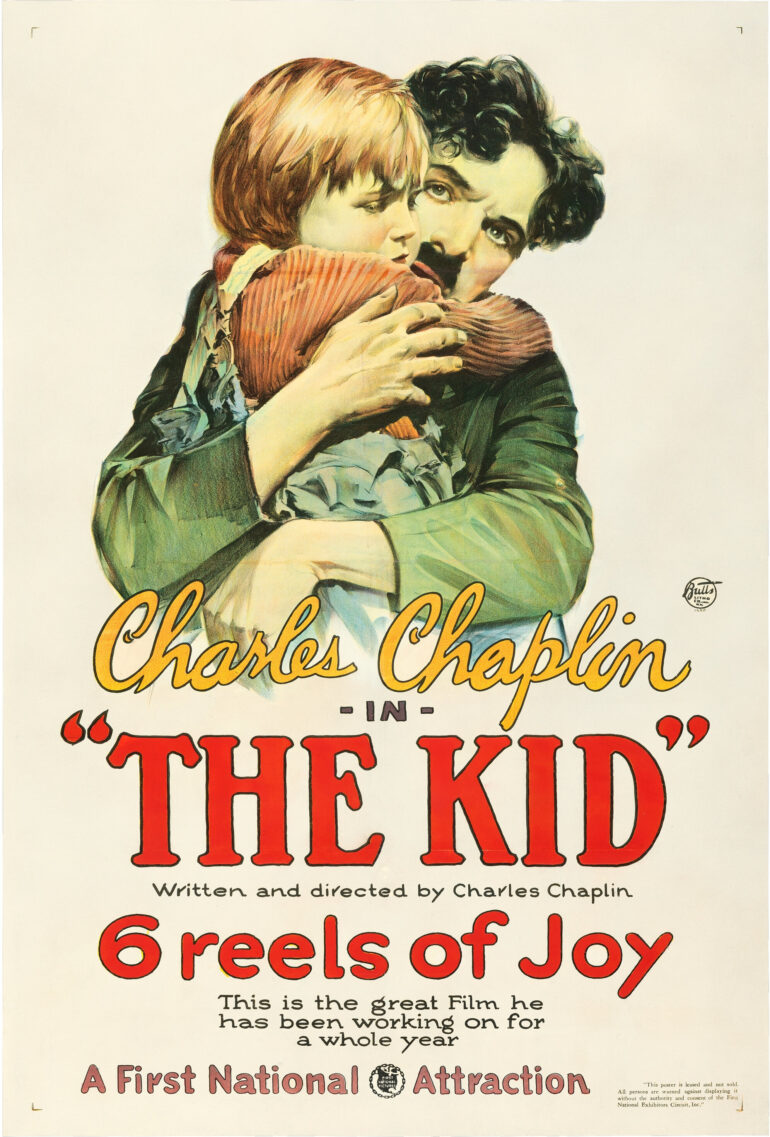
I watched The Kid when I needed something short, but it ended up being too short. I found a “feature-length” Chaplin film that is, in today’s attention economy, practically a haiku: 53 minutes. Only later did I learn that this was not the original cut at all, but Chaplin’s 1972 re-release, shortened from the original 68 minutes. The original movie poster’s brag “6 reels of joy” becomes, by my petty arithmetic, something closer to “5 reels of joy”. And I don’t believe authors are the best judges of their own work; who knows: I might have enjoyed the removed 15 minutes a lot.
My main reaction, incompatible with a reverent kneel before the canon: I found the film a tad disappointing. Not bad. Not weak. Just… not the kind of “pantheon Chaplin” I associate with Modern Times (1936) and especially The Great Dictator (1940). I wouldn’t hesitate to nominate The Great Dictator for the greatest film ever made by anyone anywhere; The Kid, by contrast, is not that kind of film. It’s Chaplin’s first full-length venture, and it still feels like an artist testing what a longer format can carry. It is “Chaplinian” in the familiar sense: slapstick punctured by emotion, comedy braided with seriousness. Critics tend to praise it for how it blends laughs with bathos.
But what struck me even more was a different blend: slapstick with a merciless depiction of human nature.
There’s a brutal undercurrent running through the film. You can call it an undertow, or in musical terms a bassline: the comedy is the melody, but underneath it thumps something colder. People behave with astonishing ruthlessness, opportunism, and avarice toward one another. They exploit weakness. They outsource cruelty to institutions. They obey incentives rather than conscience. Schopenhauer is often lazily labeled “the king of pessimists”, and I suspect he would have appreciated The Kid precisely because it doesn’t flatter humanity. Kindness exists, but it feels like a fragile exception rather than the default. The film’s “sweetness” is real, but the film’s cynicism about society is real too.
And yet: the heart of the film, and the reason it still works, is Chaplin’s Tramp.
What’s remarkable about the Tramp isn’t that he’s an underdog. It’s that he’s a ridiculous underdog who insists on dignity. He walks with that absurd flat-footed saunter, as if he owns the street. His shoes are falling apart, his pants are patched and baggy, and still his outfit remains, in its stubborn structure, a gentleman’s attire: coat, vest, tie, hat, cane. A tramp dressed like a battered gentleman, refusing to be spiritually reduced.
That’s oddly inspiring even now. I’m a voluntary minimalist by temperament (and, yes, sometimes by necessity), while the Tramp has no such choice. But the posture is the point: you can be poor and still carry yourself as if you have a spine. You can be ridiculous and still be dignified.
Then there’s the pure time-machine value: the period detail. You’re not only watching a story; you’re watching 1921 itself leak into the frame: clothing, streets, interiors, social hierarchies, the physical reality of poverty. One detail hit me hard: the flophouse sequence, that grim lodging house vibe that still feels like social history rather than film history. Even the mundane mechanics of the room (how light is switched on and off) becomes weirdly fascinating, because it reminds you how physically different daily life was a century ago.
Another point is Chaplin himself as an almost absurd one-man factory. He is the film equivalent of Prince of Minneapolis: the kind of genius who seems temperamentally incapable of not doing everything. Chaplin wrote, directed, acted, edited, and later even scored his films. (In this case, he composed and recorded a new score for the 1972 re-release.) According to the Criterion extras, he also insisted on doing stunts himself rather than using doubles. Whether this is admirable or insane depends on your blood pressure, but it does deserve respect.
And then there’s the film’s lengthy concluding “Dreamland” sequence, with neighbors turned into angels and devils. It’s striking, playful, and a little weird. One “flirtatious angel” does a seductive dance that would be unremarkable if the performer were an adult. Later, though, I learned that the actress was Lita Grey, and she was about 12 at the time (just made to look older). Those scenes likely couldn’t be shot today. Chaplin later married Grey when she was 16 after she became pregnant, while he was already in his thirties. (And that was not the only teenage girl he became intimately associated with.) I wonder how Chaplin would be perceived nowadays if he was a contemporary artist, given recent scandals in this vein.
The historical irony is that Chaplin was effectively driven out of the U.S. not for his morals but for political reasons during the anti-Communist witch hunt era. Fortunately, he later returned for a major public honoring in 1972, receiving a famously long standing ovation when he accepted his honorary Oscar. The same year, he premiered this shortened re-release of The Kid.
It’s embarrassing that “it took me 105 years” to watch a 1921 film. Yet even the film’s child star, 4 at the time of shooting, Jackie Coogan, only got to watch the movie when he was 20 – at Chaplin’s insistence.
The Kid didn’t overwhelm me the way Chaplin at his peak can. But it still reminded me why Chaplin became universal: not because he was cute, but because he understood something bleak about people, and still insisted on dignity.
Disclosure: This review was drafted by ChatGPT from my dictated notes in its app, which were based on bullet notes in Obsidian.

Leave a Reply